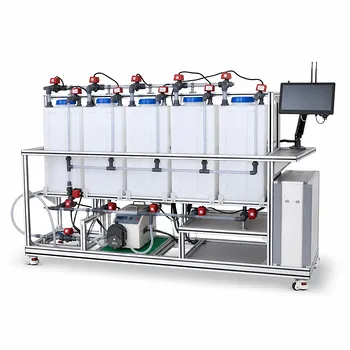
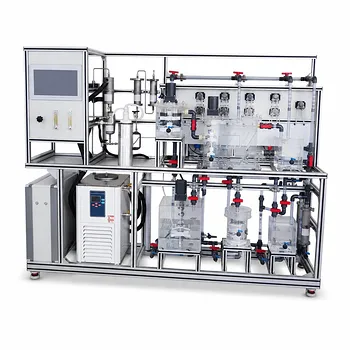
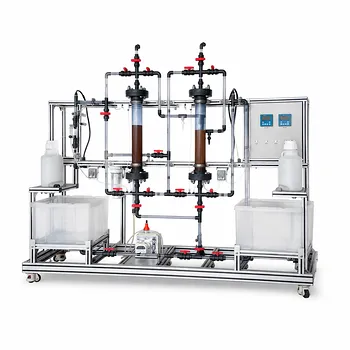
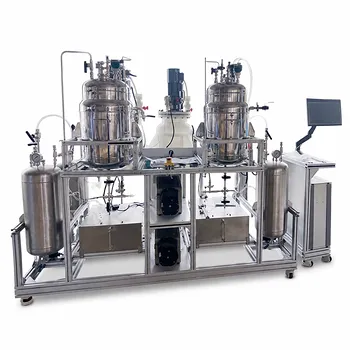
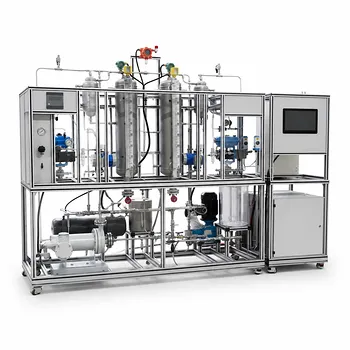
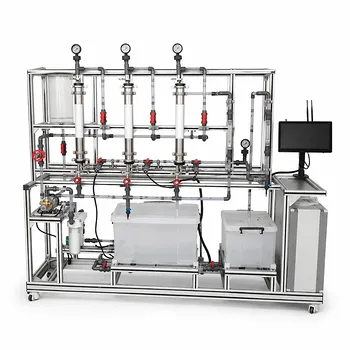
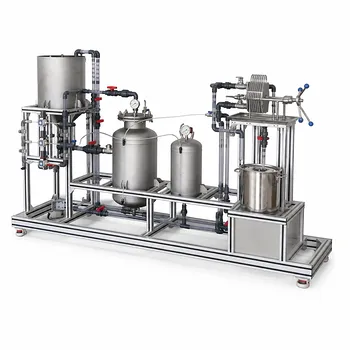
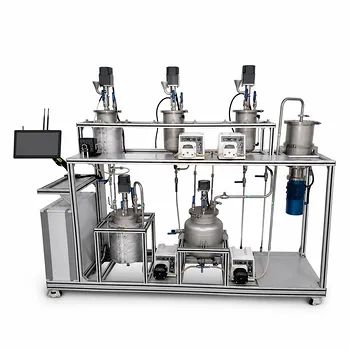
دور الشب كمُساعد على التخثير في التليين الكيميائي ليس سحراً—it’s a stepwise process of charge neutralization, hydrolysis, and adsorptive flocculation. A laboratory-scale pilot plant makes each of these invisible mechanisms visible by letting you control the chemistry and watch the particles. You can directly correlate a measured drop in turbidity and magnesium concentration to the formation of a gelatinous aluminum hydroxide floc that sweeps up softening precipitates.
Chemical softening produces a heavy slurry of calcium carbonate and magnesium hydroxide, but these fine particles resist settling. Alum solves this by introducing positively charged hydrolysis species that neutralize repulsive charges and create a sticky, net-like floc. Pilot plant experiments demonstrate this mechanism concretely when you observe the dramatic change from a milky, stable suspension to a clear supernatant with a dense sludge blanket, all while tracking the underlying water chemistry.
تحديد مشكلة التليين الجوهرية بدون مُساعد على التخثير
طبيعة رواسب التليين
In lime or lime-soda softening, hardness ions are converted into calcium carbonate (CaCO₃) and magnesium hydroxide (Mg(OH)₂). Both are crystalline or amorphous solids with a slight negative surface charge in alkaline water. These like-charged particles repel each other, preventing them from aggregating into settleable flocs. The result is a persistent, high-turbidity suspension that requires hours or days to clarify by gravity alone.
لماذا يفشل الترسيب بدون مساعدة
Pilot columns without a coagulant aid quickly reveal the practical bottleneck. Even after complete chemical reaction, the water remains hazy and supernatant turbidity stays unacceptably high. This visual observation is the first lesson: chemical conversion is not the same as physical separation. You need a bridge to overcome the electrostatic barrier and link the tiny particles into larger, heavier aggregates.
كيف تكشف محطة التجربة عن الآلية متعددة الخطوات للشب
الخطوة 1: تصور تحييد الشحنة
When you dose alum into the softening reactor at mixing speed, trivalent aluminum ions (Al³⁺) and their hydrolysis products (e.g., AlOH²⁺, Al(OH)₂⁺) adsorb onto the negatively charged precipitate surfaces. The immediate effect—seen in a jar test or continuous-flow pilot—is a reduction in zeta potential. While a small pilot may not measure zeta potential directly, you infer neutralization from the onset of microfloc formation. Tiny pin flocs become visible within seconds, signaling that repulsive forces have collapsed.
الخطوة 2: ملاحظة التحلل المائي وتكوين التكتل المسحافي
In the high-pH environment of softening (typically pH 10–11 for Mg removal), added alum hydrolyzes rapidly to form amorphous aluminum hydroxide, Al(OH)₃. This gelatinous precipitate appears as a voluminous, fluffy floc. The pilot plant demonstrates the mechanism by letting you contrast a run without alum—where precipitates remain dispersed—with a run where the floc blanket grows thick and settles fast. The Al(OH)₃ acts as a three-dimensional net that physically enmeshes CaCO₃ and Mg(OH)₂ particles, a process called sweep coagulation.
الخطوة 3: تتبع الامتصاص والدمج
As the hydrolysis floc matures, dissolved and colloidal species adsorb onto its vast surface area. Pilot experiments can prove this adsorption mechanism by measuring the removal of magnesium beyond the stoichiometric expectation of simple precipitation. For example, you might observe that the residual magnesium concentration drops more when alum is added as a coagulant aid than when Mg(OH)₂ is precipitated alone, thanks to adsorptive coprecipitation on the aluminum hydroxide floc.
الخطوة 4: قياس الأداء من خلال المعلمات الرئيسية
The pilot plant makes the mechanism tangible through routine measurements. You sample the clarified water and track:
- إزالة العكورة: A sharp decrease from, say, 50 NTU to below 1 NTU confirms that the floc successfully captured and settled the fine solids.
- تقليل المغنيسيوم: Lower Mg²⁺ levels directly tie to the adsorption-sweep mechanism.
- حجم الحمأة وسرعة الترسيب: A compact, fast-settling sludge indicates effective flocculation, while a slow-settling, diffuse blanket suggests insufficient coagulant aid.
By varying alum dose, pH, and mixing intensity, you generate rate-of-change data that mirror the kinetics of hydrolysis and floc growth.
فهم القيود والمفاضلات في العرض على نطاق محطة التجربة
خطر الجرعة الزائدة
While more alum can produce more sweep floc, an excessive dose reverses the surface charge and restabilizes particles. The pilot plant shows this clearly: as alum dose crosses the optimum, settled water turbidity suddenly rises again. This classic U-shaped curve teaches that the mechanism only works within a narrow window of electrochemical balance.
الألمنيوم المتبقي وانخفاض الأس الهيدروجيني
Each milligram of alum added consumes alkalinity and lowers pH. In a softening pilot, you will see the treated water pH drop from the set point if the alum dose is not compensated with additional lime. Moreover, high residual aluminum in finished water is a health concern and a violation of drinking water standards. The pilot reveals that the sweep mechanism requires precise chemical control—otherwise, the coagulant aid becomes a contaminant.
حساسية درجة الحرارة والمزج
Laboratory pilots also expose the kinetic constraints. Cold water slows hydrolysis, requiring longer flocculation times. Inadequate rapid mixing after alum injection leads to uneven distribution and localized over- or under-dosing, masking the true mechanism. These nuances remind you that bench-scale results must be interpreted with an eye on operational realities.
كيف تطبق هذا على دراسة التجربة أو المختبر الدراسي الخاص بك
Based on what you intend to demonstrate, tailor your pilot plant protocol and data interpretation.
- إذا كان تركيزك الأساسي هو تدريس الكيمياء الأساسية: Use a series of jar tests where you hold lime dose constant and stepwise increase alum dose. Measure pH, turbidity, and magnesium after a fixed settling time. The turbidity valley will physically display the transition from charge neutralization to sweep flocculation to restabilization.
- إذا كان تركيزك الأساسي هو تحسين العملية لمحطة كاملة الحجم: Operate a continuous-flow pilot with online turbidimeters and pH probes. Log turbidity in the sludge blanket and effluent while changing alum feed rate. Correlate excursions in effluent turbidity with changes in floc morphology to define the operational boundaries of the sweep mechanism.
- إذا كان تركيزك الأساسي هو التحقق من إزالة ملوثات محددة: Spike feed water with known concentrations of dissolved metals that may co-precipitate. With and without alum, measure the metal partitioning into the sludge. This demonstrates that aluminum hydroxide floc is not just a settling aid but an active adsorbent for trace constituents.
A properly instrumented laboratory-scale pilot plant transforms the abstract textbook mechanism of coagulation in softening into a visible, measurable, and tunable process. By tracking what your eyes see—the floc—and what your instruments tell you—the turbidity and magnesium numbers—you can confidently demonstrate exactly how and why aluminum sulfate functions as a coagulant aid.
جدول الملخص:
| الخطوة | الآلية | الملاحظة البصرية | المعلمة الرئيسية المتتبعة |
|---|---|---|---|
| 1. تحييد الشحنة | Trivalent Al³⁺ neutralizes negative surface charges on CaCO₃/Mg(OH)₂. | Formation of tiny pin flocs | Zeta potential / microfloc onset |
| 2. التكتل المسحافي | Alum hydrolyzes to gelatinous Al(OH)₃, enmeshing fine particles. | Rapidly settling, voluminous floc blanket | Turbidity reduction & settling velocity |
| 3. الامتصاص | Dissolved & colloidal species adsorb onto the massive floc surface. | Clear supernatant and dense sludge | Residual magnesium & metal levels |
أحضِ كيمياء معالجة المياه إلى الحياة مع LABPARK
Bridge the gap between theoretical chemistry and hands-on process engineering. LABPARK provides state-of-the-art Educational and Vocational Unit Operations Pilot Plants across chemical engineering, bioprocess & biotech, and environmental & water treatment.
Designed specifically for universities, research institutes, and enterprises, our pilot plants allow you to:
- Demonstrate complex physical-chemical mechanisms (like coagulation and softening) in real-time.
- Conduct precise process optimization, testing, and scaling studies.
- Train students and operators on industrial-grade instrumentation and control systems.
Ready to enhance your teaching or research lab? Contact LABPARK today to find the perfect pilot plant solution for your institution!
المنتجات ذات الصلة
- وحدة تجريبية للعمليات الوحدية لمعالجة المياه الكهروكيميائية
- وحدة تجريبية تعليمية لمعالجة غاز العادم والمياه المتبقية من الحرارة الفيزيائية
- محطة تجريبية تعليمية لتنقية المياه بالتبادل الأيوني لعمليات الوحدات الهندسية
- وحدة تعليمية تجريبية لإنتاج وتخزين الهيدروجين بالتحليل الكهربائي للمياه
- مصنع تجريبي تعليمي للتقطير المستمر والدفعي الاستخلاصي
يسأل الناس أيضًا
- ما هي ميزات التصميم التي تستخدمها محطات التجارب الكهروكيميائية التعليمية لإدارة تحرير الغاز وفقدان الماء؟
- كيف يمكن لمصانع تجريبية للعمليات الوحدة إظهار تركيز حمض الرصاص مقابل حالة الشحن؟ دليل للمراقبة في الوقت الفعلي.
- كيف تقوم وحدات الالكتروليز التعليمية النموذجية بتوسيع نطاق عملية التحليل الكهربائي؟ إتقان هندسة العمليات الصناعية.
- كيفية تقدير الكبريتات في رواسب محطات المعالجة التجريبية للمياه: دليل التحليل الوزني
- كيف يمكن إدارة الرغوة أثناء تجارب توليد البخار في المصانع التجريبية لعمليات معالجة المياه؟ نصائح