إليك الرؤية الحاسمة: إن اللزوجة العالية لمحاليل البوليمر المركزة تقلل بشكل كبير من حركة الجزيئات، مما يحول الاقتراب من اتزان الطور إلى عملية بطيئة محدودة حركياً. في عمليات التفاعل والخلط في الوحدات التجريبية، هذا يعني أن المقاييس الزمنية اللازمة لتوزيع الطور المتجانس والاتزان المستقر تتجاوز بكثير تلك الخاصة بالسوائل ذات اللزوجة المنخفضة. وبدون التخفيف الصريح، غالباً ما تلتقط قياسات حدود الطور حالة عابرة، وليس الاتزان الديناميكي الحراري الحقيقي.
في الوحدات التجريبية للبوليمرات، الاتزان ليس أمراً مفروغاً منه—it’s a target that must be engineered. High viscosity transforms the challenge from a simple mixing problem into a careful orchestration of time, temperature, and mechanical energy to coax the system toward a stable state without destroying the polymer itself.
لماذا تحول اللزوجة الاتزان إلى تحدٍ حركي
في أنظمة البوليمر المركزة، العامل نفسه الذي يجعل السائل صعب التعامل يعيد أيضاً تعريف معنى "الاتزان" من الناحية التشغيلية. لا يكفي معرفة النهاية الديناميكية الحرارية؛ يجب أولاً التغلب على الحاجز الحركي الذي يقف في الطريق.
دور الحركة الجزيئية المتأخرة
اللزوجة هي مقياس مباشر لمقاومة السائل للتدفق—and to molecular diffusion. In a concentrated polymer solution, entangled chains and sparse free volume create an environment where every molecule moves sluggishly.
This sluggishness means that the diffusive processes responsible for achieving compositional, thermal, and mechanical equilibrium are orders of magnitude slower than in simple liquids. A system that, in theory, should reach a stable phase distribution within minutes may instead take hours or even days.
تباطؤ فصل الطور والامتزاز
The kinetic drag is especially stark in phase‑separation processes. For example, measuring a depression of the glass transition temperature in a polymer‑plasticizer mixture requires the plasticizer molecules to distribute uniformly through the polymer matrix. High viscosity makes this diffusion so slow that the measured transition can drift for hours before settling—leading to irreproducible data if the observation time is too short.
Similarly, in solid‑liquid adsorption systems (such as polymer chains adsorbing onto silica), high solution viscosity chokes the mass transfer rate of polymer molecules toward the surface. What might be a rapid adsorption equilibrium for small molecules becomes a prolonged, sluggish crawl. Pilot‑plant instructors and students quickly learn that equilibrium assumptions break down unless contact times, flow rates, and agitation are adjusted deliberately.
المخاطر العملية في القياس والتشغيل
Ignoring the kinetic reality of viscous polymer solutions leads directly to two classes of failure: misleading equilibrium data and incomplete mixing in the unit operation itself.
وقت الإقامة غير الكافي وبيانات مضللة
Standard mixing vessels and pilot‑plant protocols are often designed around the behavior of low‑viscosity fluids. When applied to concentrated polymer solutions, they routinely fail to provide enough residence time for the system to approach phase equilibrium.
The result is a snapshot of a metastable state. Operators may record a “phase boundary” that is actually a transient inhomogeneity. This error propagates into scale‑up, reactor design, and quality predictions. Reproducible measurements of phase transitions therefore demand prolonged stabilization periods and repeated sampling until no drift is observed.
الخلط غير الكافي وعدم تجانس الطور
Beyond measurement, the core unit operation suffers directly. A mixing vessel may exhibit stagnant zones or dead spots where the local composition never reaches the target value. Even when the average composition looks correct, the spatial distribution can be far from equilibrium, compromising reaction yield, polymer properties, and safety.
Pilot‑plant operators are therefore forced to think beyond simple residence‑time distributions. They must actively manage the interplay of viscosity, flow pattern, and equipment geometry to drive the system toward a truly uniform state.
التنقل بين المفاضلات: السرعة، والسلامة، والاستقرار
Addressing the viscosity problem is not simply a matter of adding more mixing power. Every solution introduces a trade‑off that can damage the very polymer you are trying to process. Understanding these tensions is the hallmark of competent pilot‑plant design.
تحسين القص ودرجة الحرارة لخفض اللزوجة
Two powerful levers are available: temperature and shear. Elevating the process temperature reduces solution viscosity by increasing molecular mobility and decreasing entanglement, accelerating the approach to equilibrium. Similarly, applying controlled shear can continuously deform the fluid and refresh interfacial area, aiding mass transfer.
However, neither lever is free. Raising temperature too aggressively risks thermal degradation of the polymer, altering its molecular weight and phase behavior. The art is to find a temperature window where viscosity drops enough to allow practical equilibration times while keeping the polymer chemically stable.
خطر تقطع السلسلة الناتج عن القص
High‑shear mixing seems like a natural answer—it forcibly convects material, breaks up concentration gradients, and cuts equilibration time. But concentrated polymer solutions are mechanically fragile under aggressive flow. The shear forces that accelerate mass transfer can also be energetic enough to break covalent bonds along the polymer backbone.
Once chain scission occurs, you are no longer equilibrating the original polymer. You have fundamentally changed the system, often shifting its phase behavior and molecular weight distribution. This is why pilot plants designed for polymer thermodynamics must use specialized low‑shear agitation systems, such as helical‑ribbon or anchor impellers, and tightly control energy input.
عندما يكون البطء هو السرعة: حالة الاتزان التدريجي
The degradation risk pushes the operation toward a counterintuitive philosophy: sometimes, the fastest path to reliable equilibrium is to move slowly. Using highly controlled thermal environments and gentle, continuous mixing allows mass transfer to proceed without damaging the polymer structure. In a teaching pilot plant, this trade‑off vividly illustrates the difference between processing Newtonian fluids and complex polymeric materials—and why process intensification must always be tempered by awareness of molecular limits.
اتخاذ الخيار الصحيح لهدف وحدتك التجريبية
The strategies you adopt must align with what you are trying to achieve—be it precise thermodynamic data, polymer integrity, or a scalable unit operation.
- If your primary focus is measuring accurate phase boundaries: Design experiments with stabilization periods on the scale of hours or days, and use in‑situ, non‑invasive probes (optical or dielectric) to track the approach to equilibrium. Never assume that a few minutes of mixing is sufficient.
- If your primary focus is preserving polymer molecular structure: Select low‑shear agitation equipment and a process temperature that keeps viscosity manageable without exceeding the polymer’s thermal stability limit. Accept longer batch times as a necessary price for maintaining chemical integrity.
- If your primary focus is scaling up a mixing or reaction process: Account for non‑equilibrium effects in your residence‑time distribution and consider a multi‑stage approach where early stages pre‑condition the fluid to a lower viscosity before final mixing. Always validate that the product you create at scale matches the lab‑scale equilibrium benchmark.
Mastering phase equilibrium in viscous polymer solutions requires shifting your mindset from assuming equilibrium to actively engineering it—through a delicate balance of time, temperature, and gentle mechanical force.
جدول الملخص:
| التحدي | التأثير على اتزان الطور | استراتيجية التخفيف |
|---|---|---|
| الحركة الجزيئية المتأخرة | الانتشار بطيء للغاية وأوقات استقرار تمتد لساعات. | ارفع درجة الحرارة بأمان واسمح بفترة استقرار طويلة. |
| عدم تجانس الطور | مناطق راكدة وتوزيع مكاني غير متساوي في الخلط. | تحسين هندسة الوعاء وتنفيذ التكييف المسبق متعدد المراحل. |
| التدهور الناتج عن القص | تقطع السلسلة يغير الوزن الجزيئي وسلوك الطور. | استخدم خلطاً منخفض القص (مثلاً: مراوح شريطية حلزونية أو مراسي). |
حسن عمليات وحدات البوليمر الخاصة بك مع LABPARK
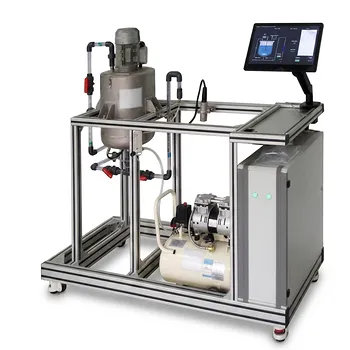
Overcoming the kinetic challenges of high-viscosity polymer systems requires specialized, precision-engineered equipment. LABPARK provides state-of-the-art Educational and Vocational Unit Operations Pilot Plants in chemical engineering, bioprocess & biotech, and environmental & water treatment.
Designed specifically for universities, research institutes, and enterprises, our pilot plants ensure precise control over temperature, shear, and mixing profiles to maintain polymer integrity while achieving true thermodynamic equilibrium.
Ready to elevate your research, training, or scale-up capabilities? Contact LABPARK today to find the perfect pilot plant solution for your facility!
المنتجات ذات الصلة
- وحدة عمليات تجريبية تعليمية للتكتل بالبلمرة ومعالجة الكريات
- وحدة تعليمية عمليات التشغيل التجريبية للتحريك والخلط
- مصنع تجريبي تعليمي لعمليات الوحدات لتحديد خلط الطور الغازي وتوزيع وقت الإقامة
- وحدة تجريبية تعليمية متعددة المفاعلات لعمليات هندسة التفاعل
- وحدة تجريبية لعمليات التفاعل الكيميائي في طبقة ثابتة وإزالة الغبار والقطران من الغاز
يسأل الناس أيضًا
- كيفية تكوين مصنع تجريبي للتلبيد للتحكم في الوزن الجزيئي؟ دليل الإعداد الرئيسي
- كيف تساعد وحدات العمليات التعليمية المصغرة على سد الفجوة بين النظرية والتصميم؟ سد فجوة الهندسة
- كيف تتعامل وحدات العمليات التعليمية التجريبية المصغرة مع السلامة وإدارة النفايات عند التوسع في النطاق؟
- كيف تختلف متطلبات العمليات الوحدة بين العمليات الكيميائية التقليدية والعمليات الحيوية؟ بناء مناهج أفضل للمصانع التجريبية
- كيف تربط مصانع الوحدات التشغيلية التجريبية التعليمية بين النظرية وتطوير العمليات الصناعية؟ التعلم العملي